PRESS RELEASE
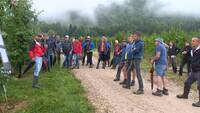
Despite bad weather, over one hundred fruit growers participated today in Denno, at the Edmund Mach Foundation’s experimental orchard in Pinè, for the Open Day event. This highly anticipated technical meeting concludes the summer series organized by the Foundation to update the agricultural sector on the main results from its experimental activities.
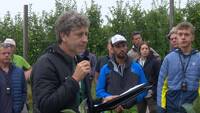
Several topics were addressed during the event, introduced by Maurizio Bottura, Director of the FEM Technology Transfer Center: from weed management to the agronomic handling of Club varieties and Renetta Canada, from orchard architecture to rootstocks, and finally to innovative distribution techniques. Growers were divided into groups to follow thematic sessions guided by FEM technicians.
Weed Management
The results of a trial focused on under-row weed management in a newly established apple orchard were presented. The trial aimed to test an alternative to chemical weeding using a biodegradable mulching film derived from cereal starch and vegetable oils. Agronomic evaluations considered productivity, fruit quality, and nutrient uptake. The data show that in young orchards, using biodegradable film represents a valid alternative to chemical weeding, providing comparable—or in some cases only slightly lower—yield and quality than conventional methods. It was also observed that poor weed management can lead to strong competition with the crop, significantly reducing plant growth in this area with virgin soil and frequent stoniness. This stress led to pronounced alternate bearing in untreated plots by the third year, whereas both standard weeding and the biodegradable film maintained consistent production over the years of experimentation.
Agronomic Management of Club Varieties and Renetta Canada
Several trials conducted at FEM experimental farms, particularly at the Denno site, were presented. These studies focus on the positive and negative effects of thinning molecules and other plant growth regulators on the productive quality of new Club varieties under observation, such as Gradisca and Kizuri. Data from pre- and post-harvest observations, crucial for the success of new varietal projects, were shared. Preliminary results from agronomic studies aimed at improving the quality of white Renetta Canada were also discussed.
Orchard Architecture
Growers received an update on the state of the art in training system experiments, particularly the “guyot” system, which allows for diverse orchard layouts to meet specific technical needs. Training techniques are now well established, and yield evaluations are satisfactory, expected to improve with extended historical data. The current experimental focus is on plant parameterization to provide simple, applicable management guidelines. A key feature of the system is the replacement of vertical axes: determining their number, length, and correct renewal rhythm optimizes critical operations such as pruning and fruit thinning.
Rootstocks
Ongoing trials on traditional and Geneva® rootstocks were presented, aimed at evaluating performance based on varietal combinations and pedoclimatic conditions. Some rootstocks showed significant advantages, particularly in early cultivation years, in terms of quality and productivity. Observations on Fengapi Tessa® indicated good compatibility with certain Geneva® series rootstocks, with promising results in vegetative-productive balance. Training systems play a key role in managing vigor and optimizing plant agronomy. Monitoring in various fruit-growing areas and FEM experimental farms documented some cases of Graft Union Syndrome on G213, a phenomenon causing sudden plant decline in early years, influenced by rootstock genetics, scion variety, and propagation techniques.
Innovative Distribution Techniques
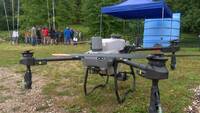
Drone use in agriculture has recently become a widely discussed topic. Although drones are not yet authorized for distributing plant protection products under EU regulations, their potential could bring major advantages, especially for crop protection in difficult mountain areas. Initial trials in Denno evaluated their capacity for drift mitigation and deposition on vegetation compared with conventional orchard sprayers. Another alternative, fixed-point distribution systems, has been successfully experimented with in recent years to control major apple diseases, reducing drift in the first meters and limiting fine droplet production easily carried by wind, as shown by Denno trials.
Photo and video coverage by FEM Press Office
Interview